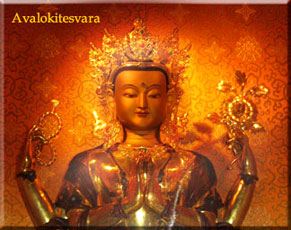
The Dharma first appeared in Tibet during the rein of Lha-Thothori Nyenten, when the Sutra of the Rites of Renunciation and Fulfillment and a tsa-tsa mound fell on the palace roof. Five generations later, in accordance with prophecies that he would understand the meaning of the sutra, there appeared the Dharma King Songtsen Gampo, and emanation of the Sublime Compassionate One (Avalokiteshvara).
 |
 |
"Whatever i know, I've left it as theory; it's no use to me now;
Whatever I've done, I've spent on this life, it's no use to me now;Whatever I've thought was all just delusion, it's no use to me now. Now the time has come to do what's truly useful...Recite the Six Syllable Mantra.
OM MA NI PAD ME HUM"
~ by Patrul Rinpoche |
During Songtsen Gampo’s reign, the translator Thonmi Sambhota was sent to India to study its languages and scripts. On his return he introduced an alphabet to Tibet for the first time. He translated into Tibetan twenty-one sutras and tantras of Avalokiteshvara, The Powerful Secret, and various other texts. He took as his queens two princesses, one Chinese (Wen Cheng Princess from Tang Dynasty) and one from Nepal (Bhrikuti Princess), who brought with them numerous representations of the Buddha’s body, speech and mind including the statues called Jowo Shakyamuni and Jowo Mikyo Dorje, the actual representatives of the Buddha, respectively. Jowo Shakyamuni statue was moulded as of 12 years old and housed at Tsuglag Khang, Lhasa, whereas Jowo Mikyo Dorje statue was moulded as of 8 years old and housed at Ramoche Temple, Lhasa. The King then built the groups of temples known as the Thadul and Yangdul, in this way he established Buddhism in Tibet.
His fifth successor, King Trisong Detsen, invited one hundred and eight pandits to Tibet, including Padmasambhava, the preceptor of Uddiyana, the greatest of the mantra-holders, unequalled throughout the three worlds. To represent the Buddha’s form, Trisong Detsen had temples built, including the “unchanging, spontaneously arisen” Samye. To represent the Buddha’s speech, the authentic Dharma, one hundred and eight translators, including the great Vairotsana, learned the art of translation and translated all the main sutras, tantras and shastras then current in the noble land of India. The “Seven Men for Testing” and others were ordained as monks, forming the Sangha, to represent the Buddha’s mind.
From that time onwards up to the present day, the teachings of the Buddha have shone like the sun in Tibet and despite ups and downs; the doctrine of the Conqueror has never been lost in either of its aspects, transmission or realization.
The lineage from Padmasambhava is known as the Nyingma School, the other three schools are Gelugpa, Sakya and Kagyu.
|
 |
Noble one, you should think of yourself as someone who is sick,
Of the Dharma as the remedy,
Of your spiritual friend as a skillful doctor,
And of diligent practice as the way to recovery.
~ Sutra Arranged Like A Tree ~
|