 OM AH HUNG VAJRA GURU PEMA SIDDHI HUNG OM AH HUNG VAJRA GURU PEMA SIDDHI HUNG
OM AH HUNG are the sublime, essence of the principles of enlightened body, speech, and mind
VAJRA is the sublime essence of the indestructible family
GURU is the sublime essence of the jewel family
PEMA is the sublime essence of the lotus family
SIDDHI is the sublime essence of the activity family
HUNG is the sublime essence of the transcendent family
“The main objective of the 100,000 Guru Rinpoche statues is to preservethe true beauty of Buddhism.
It symbolizes the peace and the happiness of the sentient beings that ultimately lead to the Enlightenment Path.”
~By Sonam Rinpoche
Guru Rinpoche's Sanskrit name is Padmasambhava. He was born in India in the early eighth century and grew up as the adoptive son of King Indrabhuti, who ruled the Kingdom of Kanci in Uddiyana, in the region that today is Kashmir. Thus, the Sanskrit name Padmasambhava in literal translation means "He who was Born out of the Lotus".
The Buddha Amithaba is said to have taken from the base of his heart a golden vajra and to have sent it into a lotus blossom that was blooming in the Dhanakosa lake in Kashmir. Out of this blossom grew a child, through which Amithaba incarnated himself, in order to spread wisdom and to tame the demons of India and Tibet.
As the wife of King Indrabhuti, who had remained childless for a long time, had mysterious dreams, these were interpreted as announcing the wonderful birth of a boy, who should become a Bodhisattva. According to the legend, one day, during a pilgrimage at Dhanakosa lake, Indrabhuti saw a boy sitting in a lotus blossom and took him in the stead of a son. On the Path to Enlightenment Padmasambhava grew up as a prince, married and ruled the kingdom of Kanci according to the commands of the holy teachings. However, he soon realized that in this way he would not be able to free the living beings from the cycle of rebirth. After Indrabhuti also was given a real son, Padmasambhava abdicated his worldly rule in favor of his younger brother.
Henceforth, he devoted his life to the deliverance of all living beings from earthly sorrow. Many god-like masters led him to the highest insights. In his meditations the Dakini accompanied him and provided him with religious enlightenment and supernatural powers. They also lent him mastery over the Gods of many worlds. First Miracles Besides being a time for the study of the holy scriptures and of meditative contemplation, these years of Padmasambhava were also a time marked by wonderful deeds. For example, during a famine in the country, he forced the Naga, the god-like guards of fertility, to refill the corn silos. The reputation of the magical Yogi soon spread. His path finally also led him to the Himalayas.
..............................................................................................................................................................................................................
Men and women who possess faith in the teachings, if they give rise to bodhicitta on a grand scale and
recite this mantra, then the benefits and advantages and energy of such practice are truly inconceivable.
This will avert all of the negative forces of disease, famine, unrest, bad harvests and all bad
omens and indications in all the countries of the world"
~ By Guru Rinpoche,"The Syllable by Syllable Commentary Explaining the Benefits of the
Vajra Guru Mantra."
The Guru as Second Buddha
Today, Guru Rinpoche counts as the founder of the
Nyingmapa
school of Buddhism. At the same time, he is one of the most prominent representatives of the tendency, already begun in Tibet in the seventh century, to merge the regional, nature-based religious cults with Buddhism.Already early on, Guru Rinpoche was portrayed as the Second Buddha. This was already indicated by the myth surrounding the birth .
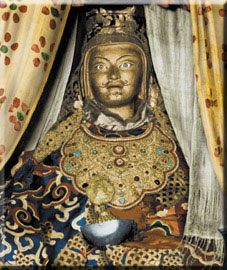
The biography of the Guru is - as one can see in the mural depicted below - analog to the life story of Buddha Shakyamuni shown through twelve deeds.From the central figure of Guru Rinpoche, the golden rays of wisdom go out in all directions. In the inside of his elbow, on the left-hand side, he holds a trident staff with three heads as a secret symbol for his tantric partner (yum). He is flanked by his tantric companions Yeshe Tshogyal,
one of the mightiest Tibetan
Dakinis
, and Mandarava,
the daughter of the King of Zahor in India.According to this, Guru Rinpoche is seen as the emanation of the body
of the Buddha
Shakyamuni
, the speech
of the
Bodhisattva
Avalokiteshvara
, and the mind of the Buddha
Amithaba
, and enjoys being worshipped in a similar manner to the Buddha himself.
................................................................................................................................................................................................................................................................................
Sponsor a Guru Rinpoche statue today, together we bring the peace to our world!
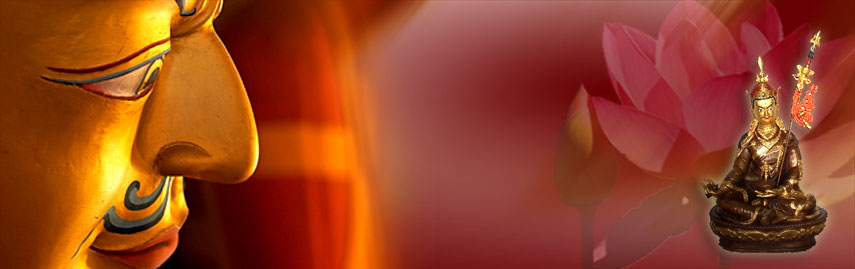
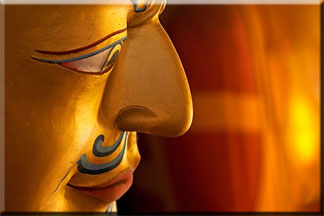
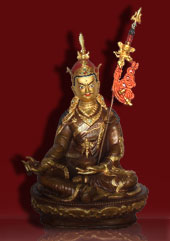
NSCF is making 100,000 nos, 8 inches tall, copper Guru Rinpoche statues, to be placed in the Nga Gyur Shed Dup Choe Ling. Guru Rinpoche statue's face is beautifully stern, almost wrathful, his eyes gaze straight ahead. He sits in lotus posture with right hand holding a vajra resting on the lap and in his left hand he holds the staff with three skulls.
 The main objectives of the project are:~ The main objectives of the project are:~
1. Buddha Dharma to be ever-flourishing especially during this degenerate age;
2. Peace, happiness and harmony to prevail in this world;
3. Warfare, famines and sicknesses to be eliminated;
4. The proceeds, after deducting the cost, will be used to fund the Nga Gyur Shed Dup
Childrens' Home.
"World peace must develop from inner peace.
Peace is not the absence of violence.
Peace is the manifestation of human compassion."
~ His Holiness the 14th Dalai Lama
|